

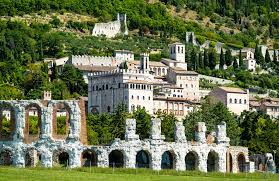
Gubbio is among the oldest cities in Umbria, wonderfully preserved over the centuries and rich in monuments that testify to its glorious past. Architecturally, it represents the masterpiece of medieval civilization and two-thirds-thirteenth-century society, articulated in the guilds of arts and crafts. Evidence of its ancient origins are the Eugubine Tables and the Roman theatre located just outside the walls. Dominating from above is the monumental basilica of Sant'Ubaldo, custodian of the remains of the patron saint.
It dates to the beginning of the 14th century, the construction of the urban complex of the Palazzo dei Consoli, symbol of the city and museum headquarters, the hanging square (Piazza Grande) and the Praetorian Palace, now the seat of the Town Hall. Also noteworthy are palazzo Beni, palazzo del Bargello with its famous fountain known as "dei Matti," palazzo del Capitano del Popolo and palazzo Ducale.
 |
 |
Also of interest are the Cathedral (12th century), dedicated to Saints Marian and James; Santa Maria Nuova, inside which is the Madonna del Belvedere by Ottaviano Nelli; the church of St. Augustine (13th century) just outside the walls; St. Peter's; and the church of St. Andrew or Monastery of St. Martial. The church of San Domenico was built by the Dominicans who settled in the nearby convent in the early 14th century, on top of the smaller church of San Martino, which already existed in 1180.
In the lower part of the built-up area is Piazza Quaranta Martiri, a market area in the Middle Ages, which houses on its southern side the church of San Francesco, erected near the Spadalonga foundry, a family that welcomed and dressed St. Francis after he left his father's home. Opposite, you can see the Loggia dei Tiratori and, also nearby, the church of San Giovanni, probably one of the oldest religious buildings in the city. Outside the walls, see the Roman Mausoleum, the church of San Secondo, the church of Madonna del Prato, and the Vittorina church.
Gubbio is surrounded by 3 mountains: San Girolamo, Monte Calvo and Monte Ingino, the most famous of the 3 because on its summit is the basilica of St. Ubaldo patron saint of Gubbio.

There are three ways to reach the summit of Mount Ingino:
-
-
- on foot, with a walk of about an hour through the woods;
- by car along a beautiful scenic road;
- or (recommended) via a cable car. The cable car station is located just outside Porta Romana, where there is also free parking.
-
The Gubbio cable car consists of uncovered cages, into which a maximum of two people can enter. They are not very high off the ground, but along the way there are beautiful views of Gubbio.
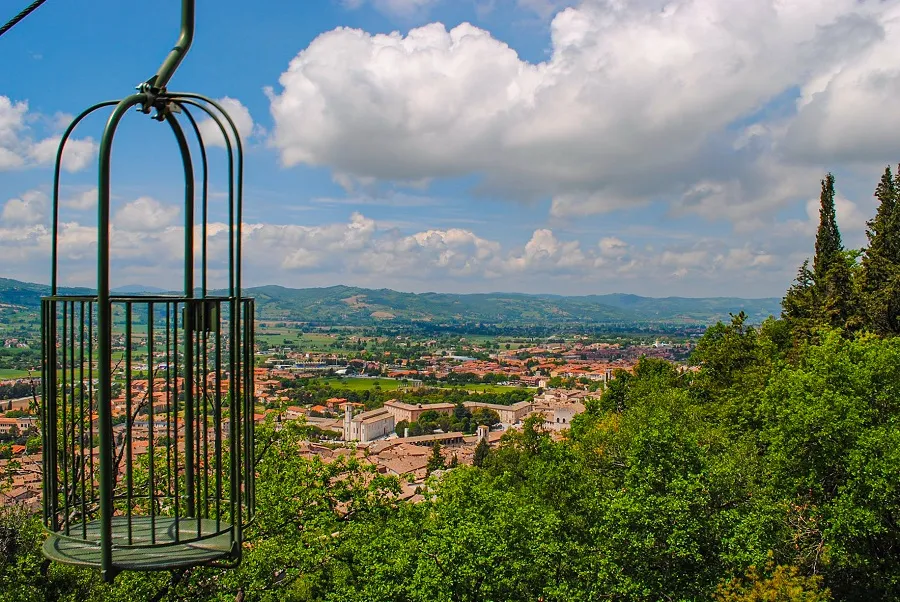
For price and times we recommend entering directly at: http://www.funiviagubbio.it/orari.asp
Once at the top, after visiting the basilica of St. Ubaldo, you can pause to admire the breathtaking view of Gubbio and its surroundings.
More information you can visit: https://www.viaggiareinumbria.com/10-cose-da-vedere-a-gubbio/