

Orvieto is a town in the province of Terni, Umbria. It is located on a rugged hill, at an altitude of 325 meters above sea level. Due to its size, it is one of the fifty largest municipalities in Italy. Orvieto is a wonderful city, as a stop in time, you will not regret visiting it.
Let’s see the main attractions what to see and do in Orvieto:
CATHEDRAL OF ORVIETO
Symbol of the city of Orvieto, the Duomo is one of the most beautiful cathedrals in Italy and the world. The beginning of the construction works is dated back to 1290 and the construction was strongly desired by both the Church and the City, with the intention of creating a single large cathedral for the city in place of the two dilapidated churches that pre-existed on the beautiful square (the Episcopal Church of S. Maria, rather mangy, and the parish church of S. Costanzo, officiated by the canons who owned houses and shops adjacent to the cloister). We must therefore exclude the suggestive theory that indicates in the Miracle of Bolsena the propitiatory event for the construction. The Duomo is a magnificent building that combines different architectural styles. In particular, it can be defined as an admirable example of balances and mixtures of Gothic (especially for the facade with the slender spires) and Romanesque styles, although the cathedral retains its own unique peculiarities. Many people and workers participated in the different phases of the design and construction of the Cathedral.
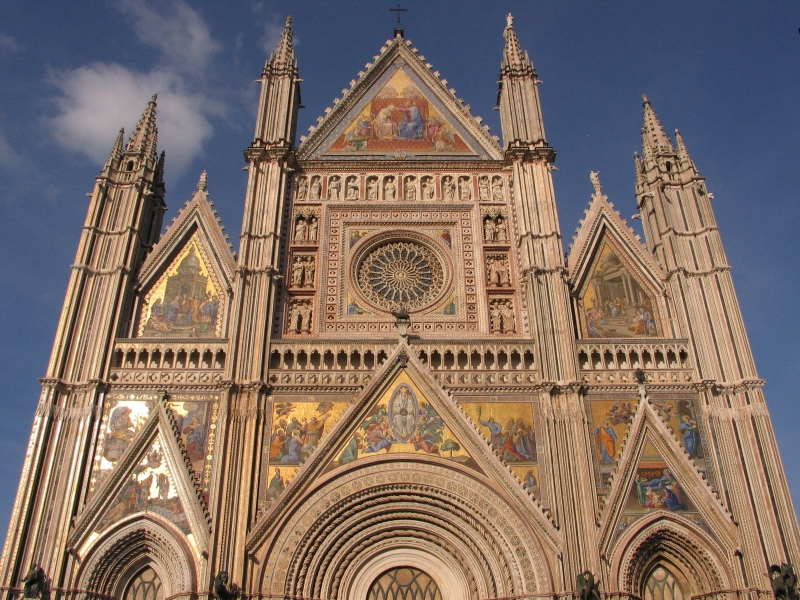
The Golden Lily of the Cathedrals
Among the many characters a particular importance have Arnolfo di Cambio and Lorenzo Maitani for the design phase (in particular the Sienese Maitani owes much of the merit for the construction of the beautiful facade) while others among sculptors, Goldsmiths, glassmakers and painters owe the work to the stage of "embellishment" and finishing of the cathedral.
Among the sculptors stands out the figure of Ippolito Scalza (local architect already creator of several works in Orvieto including the Palazzo Comunale and other interventions in several buildings). Masterpieces of the Scalza that can be admired inside the cathedral are the statue of the Pietà (or Deposition) and the majestic pipe organ.
Among the different painters a fundamental role have been played by artists of the past including Gentile da Fabriano, Lippo Memmi, Beato Angelico, Ugolino di Prete Ilario and Luca Signorelli, in particular, the realization of the splendid frescoes of the two chapels: that of the Holy Corporal and that of Saint Brizio. Much of the majesty of the cathedral is in its facade rich in details and symbols, from rose window to mosaics, from doors to bas-reliefs.
THE WELL OF ST PATRICK
It is 1527 when on the occasion of the "sack of Rome" the then Pope Clement VII takes refuge in Orvieto and by his will commissioned Antonio da Sangallo the Younger the construction of the well that was to serve as a water supply in case of siege of the city of Orvieto.
In fact, the well had, at least initially, to be used for the fortified fortress and for this reason at the time of construction it was called "Pozzo della Rocca". After a short period in which he also had the title of "purgatory of Saint Patrick" in the nineteenth century took the current name of Pozzo di San Patrizio at the behest of the friars of the convent of the Servants to whom was known the "legend of the Irish saint" (according to which Patrick was the custodian of a bottomless cave, the famous "Well of Saint Patrick" precisely, from which after seeing the pains of Hell, you could access Purgatory even arriving to glimpse Paradise). It is from this moment that the well, having now lost its primary function, and had become the object of curiosity and attraction of visitors passing through Orvieto.
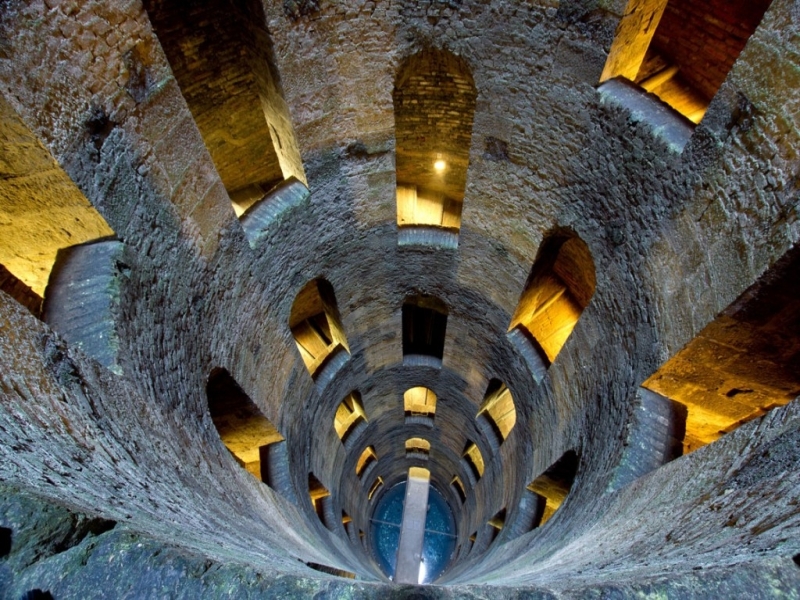
A masterpiece of Renaissance engineering
The project of Sangallo, who was already working on the fortifications of the city, was inspired by the spiral staircase of the Villa del Belvedere in the Vatican (the same architectural system is also found in the staircase of Palazzo Farnese in Caprarola) and created an ingenious helical system of steps so that the way down and up the path of the well (about 58 meters deep) did not meet each other generating problems of "traffic". Today it is a real pleasure to descend to its depths along the 248 steps that make it up to touch this work of great architectural ingenuity.
Close to Pozzo di San Patrizio:
-
-
-
-
-
-
-
-
-
- Belvedere Temple (30 mt)
- Albornoz Fortress (120 mt)
-
-
-
-
-
-
-
-
MEDIEVAL QUARTER
Orvieto "colonnacce" The medieval district of Orvieto is the oldest part of the city, the surface of the cliff that was first populated. It expands on the west side of the cliff including the steep Via della Cava and extending into the neighborhoods Serancia and Olmo where there are two ancient "fortress churches" (so called because of their massive conformation and strategic position on the perimeter of the cliff to control the territory) or that of San Giovanni Evangelista and San Giovenale.
Via della Cava was for a long time the main access to the city as evidenced by the presence of the massive Porta Maggiore (construction of the same on probably pre-existing door of Etruscan origin) and the remains of a mighty "Etruscan wall" (currently open only by reservation).

Along the steep Via della Cava there is also the entrance to the suggestive Pozzo della Cava and the small church of Madonna della Cava: one of the smallest Marian sanctuaries in Italy.
The medieval district offers really exciting views and views with small and narrow streets that alternate squares and houses built close to the tuff spurs attached to each other. Very impressive is also the path along the "Ripa Medici" and the one that from the church of San Giovanni reaches the ancient church of San Giovenale passing over the arch of Porta Maggiore. giving an overview of the particular urban structure of the neighborhood.
For more information on what to visit, please visit: Orvieto - Visitare Orvieto, turismo (orvietoviva.com)