

Perugia holds artistic and monumental treasures that bear witness to its richness.
Although it retains the appearance and pace of life of a small fortified medieval town, Perugia has a busy city life, linked above all to the presence of one of the oldest Universities of Studies in the Peninsula (founded in 1308), as well as the largest University for Foreigners in Italy.
It is therefore not a museum city, full of tourists during the day and empty at night, but a place to devote something more than a hit-and-run visit dedicated to the most important monuments. From the National Gallery to the Etruscan Well, from the Oratory of San Bernardino to the Corso Vannucci.
Perugia's Fontana Maggiore that can be admired in the center of Piazza VI Novembre is a great artistic attraction and was anciently fed by the aqueduct that drew water from Monte Pacciano, built in 1245, was an extraordinary work because without using pumps it was able to bring water to a steep and uneven city like Perugia.
 |
Decommissioned in the mid-1800s because it cost too much, today it offers one of the most beautiful promenades in Italy. The upper area, in fact, is covered with stairs and defended by parapets, thus representing a street in its own right. |
The most characteristic part is from Porta Sant'Angelo (near the Cathedral and Fontana Maggiore) with a bridge supported by a dozen bays with large arches and low, colorful houses.
|
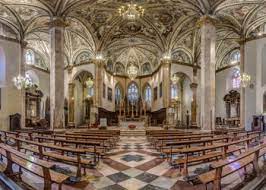
The Cathedral named after St. Lawrence, one of the city's patron saints, was built between 1345 and 1490. Both the side wall and the main facade, however, remained incomplete. Below the cloister of the Cathedral of San Lorenzo is access to Perugia Sotterranea, that is, the acropolis of Etruscan and Roman Perugia. Where the Cathedral is located, in fact, the Etruscans created a temple as early as around the 6th century BC. The most evocative part to visit of what remains of the Rocca Paolina, commissioned by Pope Paul III and praised by Carducci, are the underground passages, in particular the escalators that from the parking lot in Piazza Partigiani cross the Rocca under the side portico of the Palazzo del Governo (1870, seat of the Province) and arrive in Piazza Italia. In this truly unique and impressive setting, a kind of city within a city, there are stores, boutiques, bookshops and cultural events are often organized. |
 |
 |
The Oratory of San Bernardino was commissioned by the Franciscan friars in honour of St Bernardine of Siena, whose preaching had inflamed the people of Perugia on several occasions. The splendid polychrome façade is the work of Agostino di Duccio who, using different materials, succeeded in creating a veritable symphony of colours that explodes in a fascinating play of reflections. In a fine embroidery of stone and marble, Agostino di Duccio succeeded in glorifying Bernardino and narrating his miracles. Agostino's work is the most distinguished Renaissance monument in Perugia. |
The Etruscan Well of Perugia is a great hydraulic work that testifies to the technical knowledge and degree of civilisation reached by the people of Perugia already 300 years before Christ. Its construction seems to date back to the 4th or 3rd century B.C., but although the date is uncertain, there is no doubt about its dimensions: 37 metres deep and over 5 metres in diameter. A huge construction that served as a water reservoir in the past: the waters of no less than three of Perugia's aquifer veins flowed into it. At present, the well is passable thanks to a system of stairs that allow one to descend to the deepest point.
 |
House of Chocolate in Perugia: the Perugina factory is located just outside the city centre and it is possible to visit it and discover the history of the company and, above all, observe the production of baci (kisses) and other chocolate products. The tour is divided into three parts: it starts with the Perugina History Museum and continues in the Museum Gallery full of material from the Buitoni Perugina History Archive: pictures, wrappings, packages and films including advertising cartoons. Obviously a special space is dedicated to the history of the legendary Perugina, including the record-breaking Kiss hosted in the Museum. The tasting of Perugina products taken directly from the production line cannot be missed. Finally, it is possible to witness production thanks to an elevated tour. Finally, you can take home some tasty calories thanks to the Perugina shop! |
For more information visit: https://www.umbriatourism.it/it/perugia