

 |
On the summit stands the Rocca Flea, a superb example of military architecture originally from the 12th century, rebuilt by Frederick II in 1247 and recently restored. Inside is the Museo Civico with the large polyptych by Niccolò di Liberatore known as the Pupil (1471), sculptures, ancient ceramics and archaeological finds. |
|
Religious buildings worth a visit include the cathedral of St. Benedict (13th century) with a Romanesque-Gothic facade adorned with a beautiful double-round rose window; the church of Santa Maria dei Raccomandati (14th century), which houses a valuable triptych by Matteo da Gualdo, Madonna and Child with Saints Sebastian and Rocco; and the church of San Francesco, consecrated in 1315 and restored several times. The interior, with three ogival bays, is decorated with 14th- and 15th-century frescoes; of note are the works of Matteo da Gualdo, a distinguished painter of this town. The main square is overlooked by the Town Hall with a noble 18th-century facade, and the 13th-century Civic Tower, what remains of the Podesta's palace, to which several later buildings were attached. |
 |
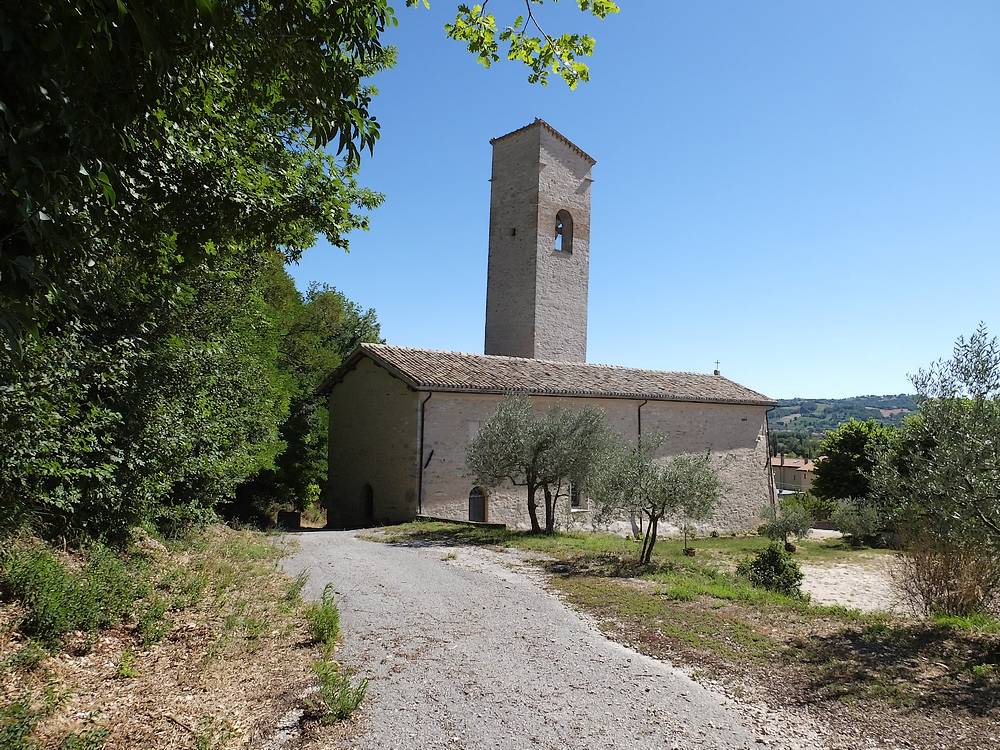 |
From Gualdo Tadino one can set out to discover the territory, which is rich in an important historical, artistic and devotional heritage evidenced by numerous examples of churches and castles. Among them: the church of San Facondino named after the bishop whose remains it preserves, is among the oldest in the territory and today is topped by the mighty bell tower carved from an ancient tower, the church of Santa Maria del Soccorso in Rigali and the remains of the ancient castle of Poggio Sant'Ercolano. In the nearby fortified village of Pieve di Compresseto, the Romanesque church of Santa Maria contains a series of frescoes, some of which can be traced to the school of Matteo da Gualdo. |
|
Gualdo Tadino is known throughout the world for its special production of majolica, which has its roots in ancient times and is distinguished by its iridescent colors of gold and ruby, obtained through the famous "lustro" or "reverberation" technique. Today in Gualdo Tadino, in addition to the artisan workshops dedicated to the production and sale of lustrous majolica, ceramics with mainly industrial characteristics are produced, with a relevant production of floor and wall tiles as well as furnishing objects and terracotta artifacts. |
 |
 |
The territory of Gualdo Tadino is characterized by numerous springs of oligomineral water. Since ancient times, the waters of this territory have been famous and appreciated, as attested by Pliny the Elder, who mentions the therapeutic springs and hot springs of Tadinum in his works. The springs are located between 600 and 700 meters above sea level and are considered to be of high purity quality with effective therapeutic virtues. They are, in fact in Gualdo the sources: Rocchetta, Santo Marzio, Capodacqua, Vaccara, Palazzo Mancinelli and Boschetto. |
More information you can find: Tadino Tourism Site