

A city of Etruscan origin that still preserves its ancient walls.
The historical centre
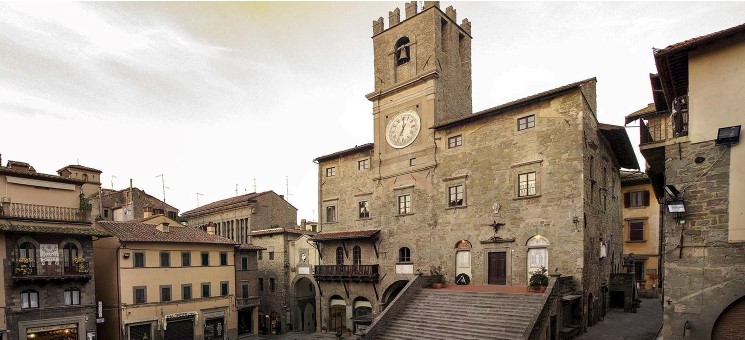 |
In the central Piazza della Repúbblica on the east side is the 14th century Palazzo Comunale with its characteristic clock tower, today the symbol of Cortona, which was erected in the 16th century. The bell tower was built together with the imposing staircase leading to the palace. Also in the square we find the Palazzo del Capitano del Popolo, (the highest in the square) a splendid building used as the residence of Cardinal Passerini in the 16th century. We move on to the adjoining Piazza Signorelli, where Palazzo Casali (16th century) stands. To the right of Palazzo Casali is the Teatro Signorelli (19th century), in neoclassical style, enriched by a beautiful seven-arched loggia. In the south-eastern part of Cortona we find Piazza Garibaldi: at its centre stands the obelisk dedicated to Giuseppe Garibaldi. From here you can enjoy a unique panorama over the Val di Chiana that reaches as far as the borders of Umbria, where you can make out Lake Trasimeno, Montepulciano and, on clear days, Mount Amiata. Stop here to enjoy this breathtaking panorama. |
MAEC - Museum of Etruscan Civilisation
The MAEC museum is currently divided into two main sections devoted respectively to the Etruscan Academy and to the Etruscan and Roman city of Cortona; the former contains evidence of the life and ongoing activity of the city's best-known cultural institution, starting with the first bequests made by academics in the 18th and 19th centuries and the purchases made over time: among the most valuable works, true 'symbols' of Cortona's culture, are the Etruscan bronze chandelier, the so-called Musa Polimnia, the collection of Etruscan and Roman ceramics and bronzes, and the Corbelli collection of materials from the Egyptian civilisation; There is no lack of more recent testimonies, such as the impressive collection of art and furniture objects formerly held by the Tommasi Baldelli family, one of the town's most famous families, or the series of works by the Cortonese painter Gino Severini, one of the founders of futurism, donated to Cortona by the Maestro himself. Many archaeological materials from the town and the surrounding area are also presented, linking up with the more modern section dedicated to their development.
For information, please visit: MAEC Cortona | Museo dell'Accademia Etrusca e della Città di Cortona | Sito Ufficiale
Diocesan Museum
|
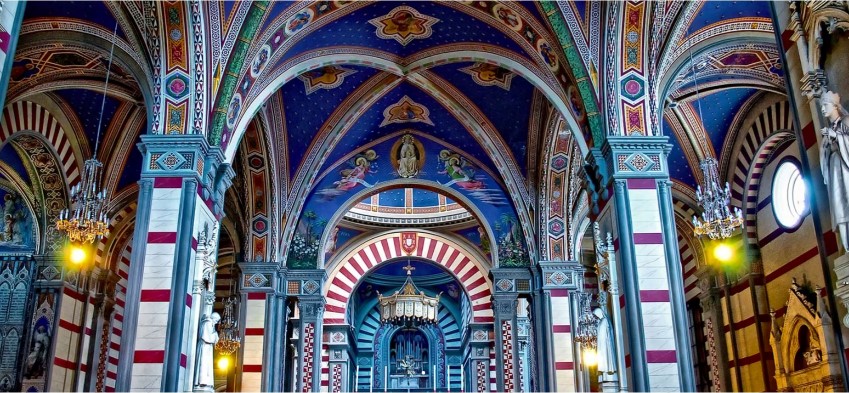
The museum is located in Piazza del Duomo, inside the former Gesù church, and collects various objects and works of art from the local churches belonging to the diocese. The art collection was founded in 1945 and preserves important works by Pietro Lorenzetti, Beato Angelico, Bartolomeo della Gatta, Sassetta and Luca Signorelli, as well as valuable sacred furnishings. The exhibition begins with the only ancient object present, of very high quality, the Roman sarcophagus with the Combat between Dionysus and the Amazons, datable to the 2nd century AD and found in the cathedral precincts. |
 |
For information visit the site: Museo Diocesano Cortona - Cortona Mia
Le Celle Franciscan Hermitage
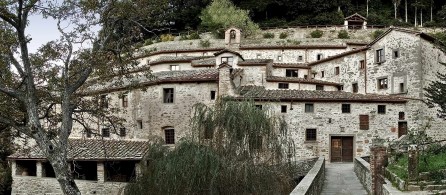 |
The hermitage of 'Le Celle' is one of the first Franciscan settlements chosen and desired by Francis of Assisi. Finding himself preaching near Cortona in 1211, as was his wont, Francis requested and obtained a place where he could retire in prayer. A young nobleman from the town, Guido Vagnottelli (who would later become 'Blessed Guido', one of the first companions of the Poverello of Assisi) offered him what at the beginning of the 13th century must have seemed a harsh place and above all devoid of any human settlement. Francis nevertheless chose it for the solitude it afforded him, but above all because it was particularly expressive of his Lord. At the place where "Le Celle" now stands, in fact, he found the vestiges of the Redeemer: water, a sign of Christ, living water; stone, a sign of Christ, the rock on which to build his life; a cleft in the mountain, a memory of the wounds of the Lord Jesus, so many times longed for by Francis, to relive in his body the love that the Lord had nourished and nourishes for every man in his passion. |
For information visit the site: Convento Francescano di Cortona - Le Celle
Sodo Archaeological Park
|
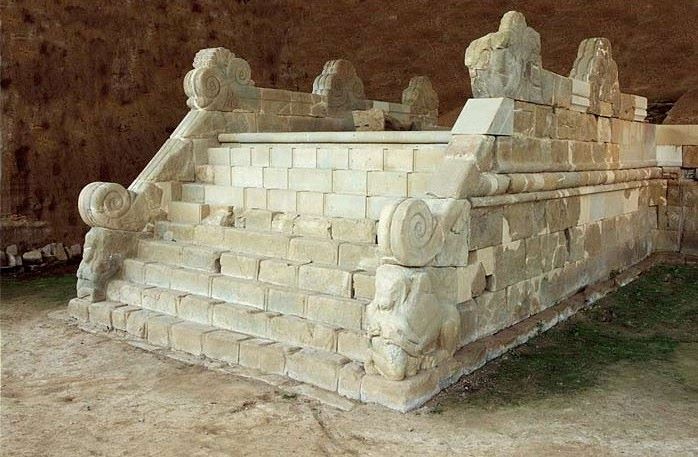
Inside the archaeological park of Sodo is Il Melone I and II, the site is located at the base of the Cortonese valley about 4 km away, on the right bank of the Loreto stream. The site is of considerable importance. Tomb I with its pseudo-vaulted roof was identified in the years 1928/29; Tomb II was identified in 1991 and yielded a very rich trove of gold jewellery, Tumulus II with its spectacular staircase-terrace decorated with sculptural groups and architectural elements in the Orientalising style. In 1990, a monumental altar-platform was brought to light on the eastern side flanking the perimeter of the tumulus, accessed via a flight of steps whose side walls are decorated with reliefs and sculptural groups. |
 |
For booking info: MAEC
The Tanella of Pythagoras
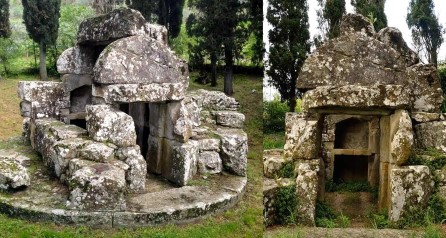 |
Descending the hill of Cortona on the foothills, amidst olive groves of rare beauty, one can visit the tanella of Pythagoras, a famous monument known to travellers since 1500. The tanella is a small tumulus from the Hellenistic period (2nd se. B.C.) consisting of a circular base on which another drum with juxtaposed blocks is set. The interior has a short dromos and a small rectangular room covered by a barrel vault. The earliest news about it refers to a visit by G. Vasari in 1566 who apparently judged it to be the tomb of Archimedes. Since then, visitors have delighted in recognising in the construction some the tomb of Ulysses, others that of Pythagoras, drawn in such attributions by the Greek-Hellenistic style of its architecture. The monument suffered progressive deterioration from the 16th to the 19th century, when French troops passing through did considerable damage to it. The most recent criticism dates it to the 2nd century B.C. It was donated to the Accademia Etrusca in 1929 by Mrs. Maria Laparelli Pitti. La Tanella can be reached by car or by trekking routes. |