


Spoleto is a pleasant city, with a beautiful historic centre full of palaces and churches to visit and a charming surrounding landscape that lends itself to walks and outings among vines and olive groves.
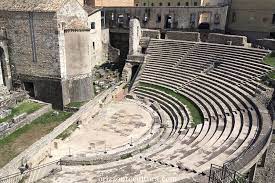
The monumental part includes the cathedral, the Albornoz fortress, the bridge of towers, the Roman theatre and archaeological museum, the churches of San Salvatore, San Pietro and San Ponziano, as well as the condotti tour, an easy, 3 km panoramic tour suitable for everyone, which runs along the slopes of Monteluco.
The city is world-famous for the 'Festival of Two Worlds', which dedicates a large space to art and its forms of expression.
The historic centre, alongside clear Roman influences, retains its medieval structure. To Spoleto's earliest origins belong the Arch of Drusus and Germanicus, a Roman arch that led to the forum (current site of Piazza del Mercato), the Romanesque church of Sant'Ansano, the Roman theatre, the basilica of San Salvatore, an interesting monument of early Christian origins (4th-5th century), a UNESCO World Heritage Site as part of the serial site 'The Lombards in Italy. Places of power (568-774 AD). A short distance from the 13th-century church of San Gregorio Maggiore, characterised by its striking apsidal area and raised presbytery, is the Roman bridge (or Ponte Sanguinario) with three arches made of travertine blocks and the Amphitheatre from the 2nd century AD.
 |
 |
 |
 |
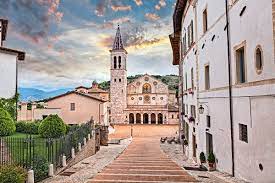
The city's largest monument is the Cathedral. Erected in Romanesque forms in the 12th century, it underwent subsequent interventions with the addition of a Renaissance-style portico. The façade is decorated with a large Byzantine-style mosaic (1207): inside, it contains a fresco of the Madonna and Saints by Pinturicchio, the bronze bust of Urban VIII by Bernini and an extraordinary cycle of frescoes by Filippo Lippi. The 12th-century church of Sant'Eufemia, an interesting Romanesque building whose apse area overlooks the steps leading to Piazza Duomo, the church of Saints John and Paul and the abbey of San Ponziano, while the 13th-century church of San Domenico, the church of San Nicolò and the Palazzo Comunale date back to the 13th century. Of great interest are the church of San Paolo inter vineas (10th century), with an important cycle of frescoes dating back to 1200, and the church of San Pietro, whose origins date back to the 5th century, with a splendid Romanesque façade carved with extraordinary bas-reliefs.
From the space in front of San Pietro, there is a wide view that embraces the whole of Spoleto as far as the mighty 80-metre-high Torri bridge, serving as an aqueduct built at the end of the 14th century, which connects the Albornoz Fortress (now home to the National Museum of the Duchy of Spoleto) to the slopes of the mountain that dominates the town. Monteluco itself, a corner of unspoilt nature, was the mountain and sacred wood of the anchorites, who settled here from the 7th century onwards, founding the convent of San Francesco (1218) and the church of San Giuliano.
Returning to the town centre, it is worth visiting Palazzo Collicola, which houses the Palazzo Collicola Arti Visive -Carandente Museum, the Bishop's Palace (Diocesan Museum), Palazzo Racani-Arroni, the Teatro Nuovo "Gian Carlo Menotti" (1854-64), the Caio Melisso Theatre, reopened in 1880, the State Archaeological Museum, in the former monastery of Sant'Agata, the Diocesan Museum and Basilica of Sant'Eufemia and the Roman House, built in the 1st century AD.
For information visit: https://visitspoleto.it/